Back Pain Treatment in Dubai: Ayurvedic Care and When to See a Doctor
What is Ayurvedic back pain treatment in Dubai?
Back pain usually eases within a few weeks, the NHS says, and its advice is to stay active. Numbness or weakness in both legs, or loss of bladder control, needs emergency care. Ayurveda fits beside medical advice as warm oil and herbal heat. At 22 Ayur the choices are Pichu, Kati Vasti, Sweda with Kizhi and a Back and Shoulder Massage, picked after a consultation.
Back pain from long days of sitting and driving in Dubai usually eases within a few weeks, and the advice is to keep moving. Some signs mean a doctor comes first. Ayurveda fits beside that medical advice as warm oil and herbal heat on a stiff back. This page helps you pick between home care, a doctor and four therapies at 22 Ayur.
Does your back need a doctor before anything else?
Start here, because some back pain is urgent. The NHS page on back pain tells you to go to an emergency department if back pain comes with any of these:
- Pain, tingling, weakness or numbness in both legs.
- Loss of feeling round the genitals or anus.
- Trouble passing urine, or loss of bladder or bowel control.
- Chest pain.
- Pain that began after a serious accident.
Get urgent medical advice if severe pain starts suddenly or is getting worse fast, or if you feel hot, shivery or unwell with it. See a doctor soon if the pain has not eased after a few weeks of home care or stops your normal day. The same goes for pain that is worse at night, sits high up between the shoulders, or comes with weight loss you cannot explain.
Pain that runs from the lower back down one leg may be sciatica, an irritated or squeezed sciatic nerve. The NHS page on sciatica says it usually gets better in a few weeks to a few months. Sciatica on both sides at once is an emergency.
What can you do yourself if you sit and drive all day?
Keep moving. The NHS advice is to stay active and carry on with your day, and not to stay in bed for long periods. It suggests back exercises and stretches, a heat pack for stiffness or spasms, and an ice pack for pain and swelling. For a painkiller it names an anti-inflammatory such as ibuprofen, and says paracetamol alone is not recommended.
For sciatica, the NHS says not to sit or lie down for long periods. A World Health Organization fact sheet on low back pain lists staying active, a healthy weight, good sleep and changes to your workplace as self care. The UAE national health survey of 2024 to 2025 found that 59.1 per cent of adults were not active enough.
The WHO says about 90 per cent of low back pain is non specific. It calls the pain acute for the first 6 weeks and chronic after 12 weeks. It also says any new low back pain deserves a clinical assessment.
Which therapy fits which kind of back pain?
Use this table as a first guess. The practitioner makes the real choice at the consultation.
| If your back is like this | Look at first | Why |
|---|---|---|
| One stiff spot in the lower back that dislikes pressure. | Pichu. | A warm oil pad rests on the spot. Nothing is rubbed. |
| A stiff, aching lower back from sitting or driving. | Kati Vasti. | Warm oil is held in a pool over the lower back. |
| Stiffness spread across the back, neck or shoulders. | Sweda with Kizhi. | Warm herb bundles carry heat over a wide area. |
| A tight back after a desk day, and little time. | Back and Shoulder Massage. | A short oil massage with firm strokes beside the spine. |
| Pain down a leg, numbness, weakness or a recent injury. | A medical doctor. | These need a diagnosis before any therapy. |
The four therapies in brief
Pichu, for one tender spot
Pichu is a thick cotton pad soaked in warm medicated oil and laid on one area. On the lower back it is called Kati Pichu. The therapist drips fresh warm oil onto the pad every few minutes, and there is no rubbing or pressure. Pick it if firm massage is uncomfortable on a tender area, or add it to the end of a massage visit.
Kati Vasti, for the long standing ache
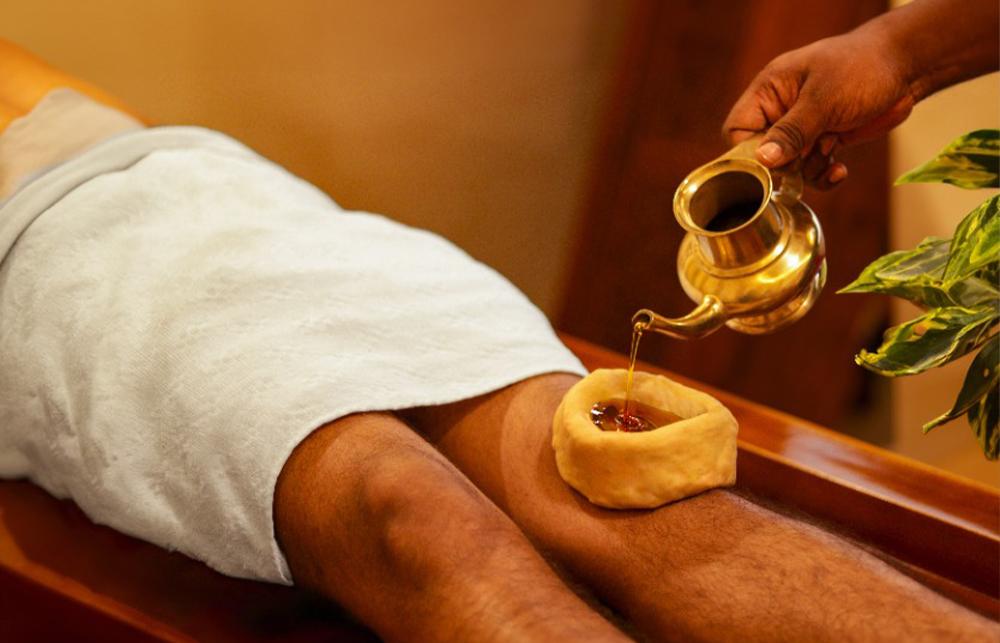
Kati Vasti holds a pool of warm oil over the lower back, inside a ring of black gram dough. Kati means the lower back. You lie face down and still while the therapist keeps the oil warm, and a gentle massage follows.
It uses more oil than Pichu and takes longer to set up. Pick it for a stiff, aching lower back from sitting or driving, when you can come several days in a row.
Sweda with Kizhi, for wide stiffness
A kizhi is a fist sized bundle of herbs, powder or rice tied in muslin. In Sweda with Kizhi the bundles are warmed and pressed over oiled skin in a steady rhythm. It covers more ground than a pad or a pool, so it fits a back, neck and shoulders made stiff by desk work or driving.
Back and Shoulder Massage, for a short visit
The Back and Shoulder Massage is a short oil massage from the base of the spine to the shoulders. Strokes run along the muscles on both sides of the spine and never on the bone. The pressure is firm, and you can ask for less. We do not call it a treatment for back pain: it is a massage for tight muscles.
A plan often pairs two of these, such as Kizhi followed by a Pichu. Our back pain and sciatica page sets out a full plan and the other therapies a practitioner may add.
What if the stiffness is in your neck and shoulders?
The same oil pool can be set on the back of the neck, where it is called Greeva Vasti. A pad fits the curve of the neck more easily, so Greeva Pichu is the other choice. Our neck and shoulder pain page covers that plan.
A shoulder that is painful and also hard to move is a different problem. Our article on frozen shoulder takes it stage by stage.
How does Ayurveda explain a stiff, aching back?
Ayurveda files back and leg pain under disorders of Vata. The Charaka Samhita (Chikitsasthana 28) describes Gridhrasi, its name for sciatica. The signs it gives are stiffness, ache and a pricking pain that runs from the buttock down the back of the thigh and calf to the sole. Its general line of care for Vata is oil first, then warmth.
The four therapies above all follow that order. Their detailed methods are not written in the old texts. A 2015 book review in the Journal of Ayurveda and Integrative Medicine says traditional physicians, above all in Kerala, adapted them and passed them on by word of mouth. The WHO benchmarks for the practice of Ayurveda now list Kati Vasti among the procedures of Ayurveda.
A classical text shows how long an idea has been in use. It does not show what the idea achieves, and it does not replace a medical diagnosis.
What has research tested for back pain?
A few trials, with modest results. A 2024 randomised trial in South India put 40 people with chronic low back pain through a one week yoga programme. Half of them had Kati Basti as well, which is Kati Vasti in another spelling. Both groups had less pain and disability at one week and at three months, with no significant difference between them.
A 2017 randomised trial of 64 people with chronic low back pain compared two weeks of Ayurvedic massage and external treatment with two weeks of local heat therapy. Pain scores were lower in the massage group at two weeks. Function and disability did not get better in the four weeks the study ran, and the authors asked for longer studies.
For massage of any kind, a 2015 Cochrane review of 25 trials in 3,096 adults found less pain in the short term than with inactive comparisons, but not in the long term. It rated the evidence as low to very low in quality. Some people had more pain after massage: between 1.5 and 25 per cent across the trials.
Our sources hold no clinical trial of Pichu, and none that compares Kizhi with no treatment. Cupping is another traditional choice for a tight back, and we offer dry cupping. A 2024 review of 11 cupping trials in 921 adults reported less pain at the end of treatment but not at later follow up. Its authors said the trials differed too much for the findings to be certain.
What these therapies offer is warmth on a stiff back. Their effect on back pain over months has not been tested well.
Who should check with a doctor before booking?
Anyone with a warning sign from the top of this page should see a medical doctor, not a therapist. Tell our practitioner before you book if any of these apply:
- Your back was injured recently.
- You have a fever, flu or a heavy cold.
- The skin on your back is broken, sunburnt or infected, or has a rash.
- You are pregnant. Kati Vasti means lying face down, which does not suit late pregnancy.
- You have reduced feeling in the skin, for example from diabetic neuropathy. Heat is kept low.
- You have a slipped disc. Bring your scan report.
Keep up any exercises from your doctor or physiotherapist, and keep taking prescribed medicine. The US National Center for Complementary and Integrative Health advises people not to use massage to put off seeing a health care provider about a medical problem.
What does a back pain visit to 22 Ayur involve?
Classical therapies such as Kati Vasti are planned after an Ayurveda consultation with Dr Thasni, our medical director and a DHA licensed Ayurveda practitioner. Expect questions about where the pain is, what brings it on, and whether you have a diagnosis or a scan. Our guide to a first Ayurvedic consultation covers the rest.
The practitioner chooses the therapy and the oil. Our article on Ayurvedic oils for joints explains the oils named for the back. Our therapists trained in Kerala, and female therapists are available on request.
The traditional course of Kati Vasti or Pichu is a session a day for seven days, which the practitioner may extend to fourteen. Kizhi for a long standing problem runs seven to fourteen days. The Back and Shoulder Massage has no fixed rule, and can be weekly, fortnightly or whenever your back feels tight.
Plan the drive home. After Kati Vasti, keep your back warm and covered for a couple of hours, and avoid lifting, long drives and hard exercise that day. Skip a cold shower straight afterwards.
22 Ayur is on Al Mina Road in Jumeirah, near Port Rashid, a short drive from Satwa, Bur Dubai and Al Karama. We are closed on Mondays, and open from 10:00 to 21:30 Tuesday to Friday and from 09:00 to 21:30 on Saturday and Sunday. You can book by WhatsApp or phone from our contact page. We give a receipt that you can submit to your insurer.
Questions people ask
How many sessions are usual for a stiff lower back?
The traditional course of Kati Vasti or Pichu is seven sessions on consecutive days, sometimes extended to fourteen. Kizhi for a long standing problem is given daily for seven to fourteen days. The practitioner sets the real number with you at the consultation.
Can I drive home after Kati Vasti?
The aftercare advice is to avoid long drives, lifting and hard exercise for the rest of that day. Book a time when the trip home is short and you can rest afterwards. Keep your back warm and covered for a couple of hours.
Is heat or ice better for back pain at home?
The NHS suggests an ice pack for pain and swelling and a heat pack for stiffness or muscle spasms. Our therapies all use warmth, so they are for the stiff, aching kind of back. They are not for a recent injury or a hot, swollen area.
Can I have Kati Vasti if I have a slipped disc?
Tell the practitioner and bring your scan report, so the plan can take it into account. If you have pain travelling down a leg, numbness or weakness, see a medical doctor first.
What should I wear to a back therapy?
Wear loose, dark clothes that are easy to change out of, because a trace of oil stays on the skin and can stain. For the Back and Shoulder Massage you lie face down with your back uncovered and your lower body draped.
Sources
- Back pain. NHS, 2026.
- Sciatica. NHS, 2024.
- Low back pain. World Health Organization, 2023.
- MoHAP Publishes Landmark National Health Survey Showing Population Health Progress and Guiding Stronger Preventive Care. UAE Ministry of Health and Prevention (MOHAP), 2026.
- Charaka Samhita, Chikitsasthana 28 (Vatavyadhi Chikitsa). Charak Samhita Research, Training and Development Centre.
- J Ayurveda Integr Med 2015. Journal of Ayurveda and Integrative Medicine, 2015;6 :143 to 144, full text on PubMed Central.
- WHO benchmarks for the practice of Ayurveda. World Health Organization, 2022.
- Effects of yoga and add on Ayurvedic Kati Basti therapy for patients with chronic low back pain: A randomized controlled trial. Bhatta M et al, Journal of Ayurveda and Integrative Medicine, 2024.
- Effectiveness of Ayurvedic Massage (Sahacharadi Taila) in Patients with Chronic Low Back Pain: A Randomized Controlled Trial. Kumar S et al, Journal of Alternative and Complementary Medicine, 2017.
- Massage for low-back pain. Furlan AD et al, Cochrane Database of Systematic Reviews, 2015.
- The effectiveness of cupping therapy on low back pain: A systematic review and meta-analysis of randomized control trials. Zhang Z et al, Complementary Therapies in Medicine, 2024.
- Massage Therapy: What You Need To Know. National Center for Complementary and Integrative Health, US National Institutes of Health, 2019.
“Back Pain Treatment in Dubai: Ayurvedic Care and When to See a Doctor” was written by the 22 Ayur clinic team. It was published and last updated . It describes traditional practice and is not medical advice. For advice on your own situation, an Ayurveda consultation at 22 Ayur is with Dr Thasni, the clinic’s medical director, who is licensed by the Dubai Health Authority as an Ayurveda Practitioner. How we review content.
Related care at 22 Ayur
- Kadeevasti / Greevasti / Januvasti
Warm medicated oil is held in a ring of dough over the lower back, neck or knee, keeping steady warmth on one area.
- Sweda with Kizhi
Warm bundles of herbs are dipped in oil and pressed rhythmically over the body, bringing moist heat to stiff muscles and joints.
- Pizhichil
Warm herbal oil is squeezed from cloths in a steady stream over the whole body while the therapists massage with the other hand.