Relax & Rejuvenate
Shirodhara
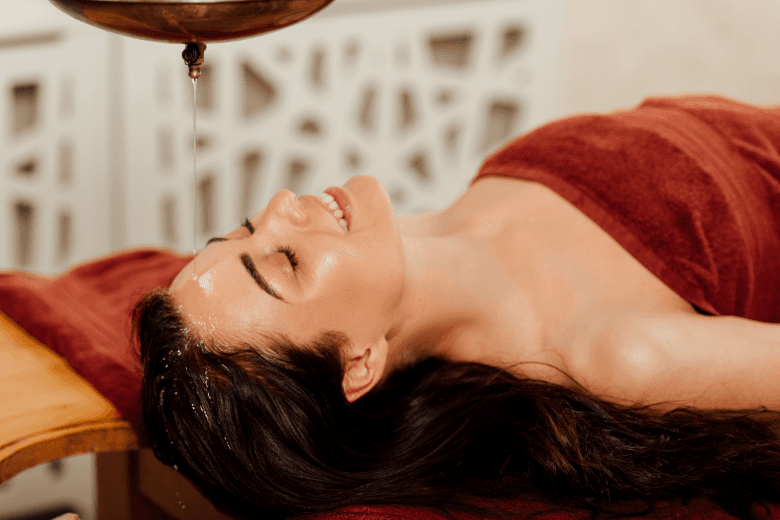
Warm herbal oil is poured in a steady stream over the forehead, moved slowly from temple to temple, while you lie still.
Shirodhara
What is Shirodhara?
Shirodhara is the pouring of warm oil over the forehead. The name joins two Sanskrit words: shiro, the head, and dhara, a flow. A steady stream of warm medicated oil runs from a vessel hung above the treatment table. The therapist moves the stream slowly from temple to temple.
Classical texts place Shirodhara among the therapies given on the head. Ayurveda uses it when it considers Vata dosha to be disturbed. Tradition links that state with a restless mind. The session itself is quiet. There is steady warmth, the rhythm of the stream and a still room. Nothing is asked of you.
At 22 Ayur the therapy is given by trained Ayurvedic therapists. The practitioner chooses the oil to suit your constitution and the season. Shirodhara is supportive care. It does not replace medical treatment for a sleep or anxiety disorder. Our practitioner will ask about your health before recommending it.
Where does Shirodhara come from?
The WHO benchmarks for the practice of Ayurveda list shirodhara as the pouring of liquid on the head, and note a form done with medicated buttermilk.
Two small trials have looked at it. In both a machine dripped the oil, not a therapist. A 2008 randomised study of 16 healthy women compared one 30 minute session with lying still. It measured anxiety scores and stress related markers. A 2016 randomised crossover pilot recruited 20 adults with sleep problems, and 15 finished. It compared sesame oil Shirodhara with warm water Shirodhara. Self rated sleep quality differed at two weeks. At six weeks the difference was unclear, and objective sleep measures showed none. Neither study is big enough to say what Shirodhara does for any condition.
The Ashtanga Hridaya (Sutrasthana 22) names four ways of putting oil on the head: massage, pouring, a soaked pad and oil held in a cap. Shirodhara grew from the second.
Key Benefits
Traditionally used to settle a busy, overworked mind
Warmth and a steady rhythm, with no pressure on the body
Traditionally chosen when Vata dosha is disturbed
A quiet, unhurried session away from screens and noise
Leaves the scalp and hair oiled
Often taken as a short course alongside Abhyangam
What happens during Shirodhara?
- 1
A short conversation
The practitioner or therapist asks what brings you in and how you have been sleeping. Tell us about any condition you have and any medicine you take. The oil is chosen at this point.
- 2
Head and shoulder massage
You lie on your back on the treatment table. The session usually opens with a gentle oil massage to the scalp, neck and shoulders. By the time the stream begins, the body has started to settle.
- 3
The stream
A vessel with a small opening hangs above your forehead. Warm oil runs through it in a thin, even stream while the therapist moves it slowly across the forehead. A cloth band keeps oil out of your eyes. The oil is collected, warmed again and kept at a steady heat throughout.
- 4
Rest
When the stream stops, the therapist wipes the forehead. You rest for a few minutes before you sit up. Get up slowly, as the body can feel heavy for a short while.
Who usually books Shirodhara?
- People with demanding, screen-heavy work who find it hard to switch off
- People who want a quiet routine at the end of a busy week
- Anyone who carries tension in the scalp, jaw and forehead
- Guests who want a quiet therapy with little physical pressure
What is Shirodhara often chosen for?
Shirodhara is often part of a plan for these concerns at 22 Ayur, and each concern page explains the approach and what it can and cannot do.
Read more about Shirodhara
- Ayurvedic massage in Dubai: Abhyangam and Kizhi
- Abhyanga at home: how to do an Ayurvedic self massage
- Stress and restless sleep: the Ayurvedic approach
- How to Choose an Ayurvedic Clinic in Dubai
- What Happens at a First Ayurvedic Consultation?
- Ayurveda for the Dubai Summer: A Seasonal Guide
- Ayurveda vs Homeopathy: What Is the Difference?
- What is Vata?
- What is Pitta?
When should you wait or ask before Shirodhara?
- Fever, a cold, or a heavy sinus infection on the day: wait until it clears
- A cut, rash or infection on the scalp or forehead
- Late pregnancy, when lying flat on the back is uncomfortable: ask the practitioner first
- If you are under care for a neurological or psychiatric condition, tell us and keep to your doctor's plan
Which oils and herbs are used in Shirodhara?
Sesame oil prepared with herbs is the classical base. Ksheerabala and Chandanadi oils are common choices in the Kerala tradition. A variant called Takradhara uses cool medicated buttermilk in place of oil. The practitioner decides on the day which one is used for you.
What should you do after Shirodhara?
- Keep the head covered and out of strong air conditioning for an hour or two
- Leave the oil in for a while if you can, then wash with a mild shampoo and warm water
- Eat something light and warm, not a heavy meal, straight afterwards
- Plan a quiet evening, not a workout or a late night
How often is Shirodhara done?
In the classical approach Shirodhara is taken as a course on consecutive days, commonly three, five or seven. Single sessions every few weeks are also common. The practitioner will suggest what fits your reason for coming.
Shirodhara at 22 Ayur is given at a clinic licensed by the Dubai Health Authority, listed on the Dubai Medical Registry as 22 Ayurvedic Center LLC. A consultation before Shirodhara at 22 Ayur is with Dr Thasni, the clinic’s medical director, who is licensed by the Dubai Health Authority as an Ayurveda Practitioner. Shirodhara is traditional, supportive care and does not replace the advice of your doctor. This page on Shirodhara was written by the 22 Ayur clinic team, published and last updated . How we review content.
Frequently Asked Questions
A warm, steady stream moves across the forehead in a slow rhythm. There is no pressure involved. You may drift close to sleep, and that is fine.
Ayurveda traditionally uses Shirodhara to settle a busy, stressed mind. The studies so far are small, and we describe two of them on this page. It is supportive care, not a treatment for an anxiety disorder. If you are under medical care for anxiety, continue it and tell our practitioner.
Arrive ten minutes early and avoid a heavy meal in the two hours before. Wear comfortable clothing. The oil will be in your hair, so bring a scarf or cap and plan to wash it later.
A course on three to seven consecutive days is the traditional pattern. For general relaxation, once every two to four weeks is common.
No. A soft cloth band is tied above the eyebrows so the oil runs back into the hair and into the tray under the table.
Yes, but sit for a few minutes first. The body can feel slow straight after the session.
Have a question about Shirodhara we have not covered? Send it on WhatsApp.
Sources
- WHO benchmarks for the practice of Ayurveda. World Health Organization, 2022.
- Psychoneuroimmunologic effects of Ayurvedic oil-dripping treatment. Uebaba K et al, Journal of Alternative and Complementary Medicine, 2008.
- Effects of Ayurvedic Oil-Dripping Treatment with Sesame Oil vs. with Warm Water on Sleep: A Randomized Single-Blinded Crossover Pilot Study. Tokinobu A et al, Journal of Alternative and Complementary Medicine, 2016.
- Ashtanga Hridaya, Sutrasthana 22 (Gandushadi Vidhi), PDF pages 367 to 370. Verse markers 26 to 33 are legible on these pages. Chaukhamba Surbharati Prakashan, Varanasi; PDF hosted by Karnataka Samskrit University.