Virechana in Panchakarma: A Guide to Therapeutic Purgation
What is Virechana in Panchakarma treatment in Dubai?
Virechana is therapeutic purgation, one of the five Panchakarma procedures. A physician first decides whether it suits you. The body is prepared with several days of oil and warmth, a measured purgative is given, and food returns in steps over about a week. The texts rule it out in pregnancy, new fever, weak digestion, bleeding from below and for people weakened by fasting.
Virechana is the purgation procedure of Panchakarma. An Ayurvedic physician gives a measured dose of a herbal purgative to empty the bowel. Days of preparation with oil and warmth come first, and days of careful eating follow. It is not a laxative to take at home.
What is Virechana?
The WHO's standard terminology for Ayurveda translates Virechana as therapeutic purgation. It defines it as purgation brought on in a controlled way, together with the steps before and after. Those steps are part of the procedure. A purge without them is something else.
It is one of the five procedures that give Panchakarma its name. In the WHO's list the others are therapeutic vomiting, two kinds of enema and medicine given through the nose. Our article on the two therapies called Vasti explains the enema.
The texts tie purgation to one dosha. Sutrasthana chapter 20 of the Charaka Samhita calls purgation the foremost measure for Pitta. It places the main seat of Pitta in the lower stomach. That is the tradition's reasoning, not a finding from a clinical trial.
Stage one: who decides, and how?
An Ayurvedic physician decides, in a consultation, before anything else happens. At 22 Ayur the physician takes your history and asks about digestion, sleep, medicines and any diagnosed condition. Your pulse is read too, and our page on pulse diagnosis explains how. The physician then judges whether a programme suits you now, and which procedures belong in it.
The texts describe a person who is ready for cleansing. Sutrasthana chapter 16 of the Charaka Samhita lists poor appetite, indigestion, heaviness, tiredness, itching and disturbed sleep. These are common complaints with many causes. If they are new, or will not go away, see a medical doctor first.
Bring a list of your medicines, including antacids and laxatives. Bring the results of any scope, scan or stool test. Our digestive health page says more about that first conversation.
Who should not have Virechana?
Many people. The classical texts are strict about this, and modern guidance adds more. Siddhisthana chapter 2 of the Charaka Samhita names those who are unfit for purgation.
- People with an injury or prolapse of the anus, or bleeding from below.
- People with weak digestion or indigestion.
- People with a new fever.
- People weakened by fasting.
- Pregnant women.
Our own Panchakarma page goes further. It rules a programme out in pregnancy and while breastfeeding, during a fever or acute illness, and while you recover from surgery. Children and frail older adults are not given the stronger procedures. With serious heart, kidney or liver disease, or during cancer treatment, we go ahead only with your specialist's agreement.
Loss of fluid is one risk. The WHO benchmarks for Ayurveda practice list the harms staff must watch for during procedures. Dehydration, electrolyte imbalance, abdominal pain, persistent vomiting, fainting, a rise or fall in blood pressure and bleeding are all on the list.
The same document asks for special care in pregnancy and during periods. It asks the same for children, older people, and anyone who is weak or has a mental illness.
The purgative is a herbal medicine. The NHS page on herbal medicines warns of interactions with warfarin, metformin, blood pressure tablets, statins, antidepressants and the combined pill. It advises against herbal medicines in pregnancy and breastfeeding, and does not recommend them for children. Speak to your doctor before you agree to purgation, and keep taking your prescribed medicines.
The texts also set a limit. Sutrasthana chapter 22 of the Charaka Samhita keeps cleansing for strong people. It lists what follows when lightening therapy is overdone: joint pain, body ache, dry mouth, thirst, fainting, and loss of weight and strength.
Some symptoms call for a doctor, not a purge. The NHS page on constipation says to see one for blood in the stool or weight loss without trying. A sudden change in bowel habit and tummy pain are on its list. It also says laxatives are for short term use only.
Stage two: how is the body prepared?
Preparation is called Purvakarma, and it has two parts: oiling and warming. Sutrasthana chapter 13 of the Charaka Samhita fixes the order. Oil comes first, then sweating, and only then cleansing.
In the texts, oiling is internal as well as external. The person also takes fat by mouth, and the chapter ranks ghee first among fats. It limits this to three or seven nights. The tradition's reasoning, in Siddhisthana chapter 1, is that oil softens the body and warmth then loosens what is to be cleared.
At 22 Ayur, preparation is several days of oil massage and steam. It typically uses medicated ghee or sesame based oils. You may be asked to eat a simpler diet at home during these days. The physician reviews how you are responding as the programme goes on.
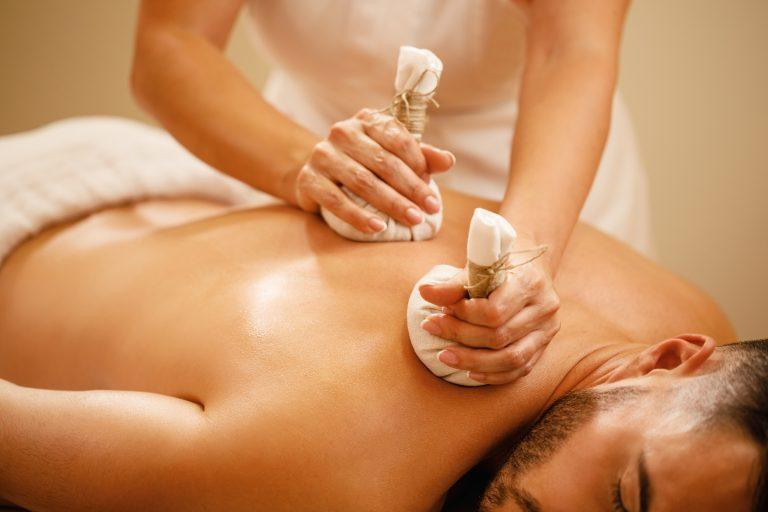
The oil massage is Abhyangam. Warmth in the Kerala tradition can also come from herbal bundles, and our Elakizhi article walks through that kind of session.
Stage three: what happens on the purgation day?
The Charaka Samhita describes the day in Sutrasthana chapter 15. Oiling and warming are repeated, and the person then takes a paste of trivrit root in a suitable liquid. The dose is set person by person. The text asks for a dose that clears enough, without doing too little or too much.
Purgation means repeated loose stools. Plan to be at home, near a bathroom, with nothing else in the day.
Watch for dehydration. The NHS page on dehydration gives the early signs as thirst, headache, dizziness, a dry mouth and dark yellow urine. Drink fluids, in small sips if you feel sick.
Get urgent medical help if dizziness on standing does not pass, you pass much less urine, or your heart or breathing is fast. Confusion, cold or blotchy skin, or being hard to wake is an emergency.
Heat raises the risk. The Dubai Health Authority's summer guideline gives daytime temperatures of 38 to 42 degrees between May and September and tells residents to drink more.
Ask what you are being given. The DHA scope of practice for traditional medicine requires a practitioner to tell you the name of each remedy. Secret remedies are not allowed.
Do not buy a purgation kit online. A 2008 study in JAMA tested 193 Ayurvedic medicines sold on the internet. About one in five held detectable lead, mercury or arsenic.
Stage four: how do you eat afterwards?
In steps. The graded diet is called Samsarjana Krama, and the texts count it as part of the procedure. The Charaka chapter on the purgation day sets it out.
Thin rice gruel comes first, for three meals. Thicker gruel follows for three, then soft rice with thin green gram soup, then thin meat soup. Warm water follows each meal, and normal food returns on the seventh night.
The steps are shorter after a milder cleansing. Siddhisthana chapter 1 gives the reason for going slowly. The digestive fire, or Agni, is like a small spark after cleansing. It has to be fed a little at a time before it burns steadily.
The texts ask for rest as well. Siddhisthana chapter 12 of the Charaka Samhita says a person after cleansing is weak and should be guarded like a brimming pot of oil. It warns against long or loud talking, bumpy travel, long walks, long sitting, sleeping in the day and eating before the last meal is digested.
At 22 Ayur, recovery begins with rice gruel and khichdi, and food stays light, warm and freshly cooked. We ask you to avoid heavy exercise, late nights, alcohol and long hours in the sun. Keep taking your prescribed medicines unless your own doctor changes them. Tell the physician promptly about anything that feels wrong.
What does research say about Virechana?
Little. We know of no clinical trial of Virechana by itself. For a whole Panchakarma programme, we know of no randomised trial that reported clinical results.
Two studies looked at short programmes. A 2009 observational study of a five day retreat followed 20 women, with no comparison group. Quality of life did not change significantly, and the authors called the results preliminary.
A 2016 study of 119 healthy adults compared six days of diet, herbs, yoga, meditation and massage with a control group. Levels of certain blood metabolites fell. It measured laboratory markers, not health. Neither was a test of purgation.
The US National Center for Complementary and Integrative Health says few well designed trials suggest that Ayurvedic approaches work. It tells readers not to use Ayurveda to put off seeing a doctor. So we make no promise about what Virechana will do for any condition, or for your weight.
Panchakarma at 22 Ayur: what a visit involves
22 Ayur is an outpatient clinic, with no overnight stays. You come in for each day's therapy and go home. A programme therefore suits adults who can commit to daily visits and a simple diet. Keep your diary clear around the main procedures.
Virechana is not on our treatment list as a session of its own. Our Panchakarma page names it among five classical procedures that the main stage can draw on. A course is planned after a consultation, and our Ayurvedic physicians follow it through.
They select what suits your constitution, your health and the time you have. Not every person has every procedure, and many programmes centre on one or two. Programmes start from seven days, and the classical range runs up to twenty one.
If cleansing is not right for you, the physician will say so. The WHO benchmarks say pacifying therapies, such as massage and sweating by heat, are used when a person is not fit for cleansing. Day to day practice mostly uses them.
A programme starts with an Ayurveda consultation with Dr Thasni, our medical director. The guide to what to expect from Panchakarma covers the whole programme. The clinic is in Jumeirah, on Al Mina Road near Port Rashid. We open Tuesday to Sunday, and you can reach us by WhatsApp or phone from the contact page.
Questions people ask
Is Virechana the same as taking a laxative?
No. The WHO's terminology defines Virechana as controlled purgation together with the steps before and after it: preparation with oil and warmth, a dose set for one person, and a graded diet. A laxative from a pharmacy is for short term use in constipation. Do not dose yourself with a purgative and call it Panchakarma.
How long does a Panchakarma programme take?
Programmes at 22 Ayur start from seven days, and the classical range runs up to twenty one. The Charaka Samhita limits oiling by mouth to three or seven nights, and its graded diet after purgation runs to the seventh night. The physician sets the length after seeing you.
Can I work during the programme?
Light work is possible on some days. Keep your schedule clear around the main procedures, and plan to be at home on a purgation day. The programme asks for rest, a simple diet and regular attendance, so a week of heavy work or travel is the wrong week to start.
Should I stop my usual medicines?
No. Keep taking prescribed medicines unless your own doctor changes them. Bring a full list to the consultation, including antacids and laxatives. Under the Dubai Health Authority's scope of practice, a traditional medicine practitioner must not change a medical doctor's prescription. Tell your doctor that you are planning a programme.
What is the diet during Panchakarma?
It is a light diet of warm, freshly cooked food such as khichdi, warm soups and herbal teas. After a main procedure, food comes back in stages, starting with rice gruel and khichdi. The physician gives you the plan, and it differs from person to person.
Sources
- WHO international standard terminologies on Ayurveda. World Health Organization, 2022.
- Charaka Samhita, Sutrasthana 20 (Maharoga Adhyaya), verses 8, 10, 13, 16 and 19. Charak Samhita Research, Training and Development Centre.
- Charaka Samhita, Sutrasthana 16 (Chikitsaprabhritiya Adhyaya), verses 13 to 23. Charak Samhita Research, Training and Development Centre.
- Charaka Samhita, Siddhisthana 2 (Panchakarmiya Siddhi), verses 8 to 23. Charak Samhita Research, Training and Development Centre.
- WHO benchmarks for the practice of Ayurveda. World Health Organization, 2022.
- Herbal medicines and complementary therapies. NHS, 2026.
- Charaka Samhita, Sutrasthana 22 (Langhanabrimhaniya Adhyaya), verses 18 to 24 and 34 to 37. Charak Samhita Research, Training and Development Centre.
- Constipation. NHS, 2023.
- Charaka Samhita, Sutrasthana 13 (Snehadhyaya), verses 9 to 28, 52 and 99. Charak Samhita Research, Training and Development Centre.
- Charaka Samhita, Siddhisthana 1 (Kalpana Siddhi). Charak Samhita Research, Training and Development Centre.
- Charaka Samhita, Sutrasthana 15 (Upakalpaniya Adhyaya), verses 8 to 17 and 22. Charak Samhita Research, Training and Development Centre.
- Dehydration. NHS, 2026.
- Summer guideline (July 2025). Dubai Health Authority (DHA), 2025.
- Traditional, Complementary and Alternative Medicine Scope of Practice. Dubai Health Authority, Health Regulation Department, 2011.
- Lead, mercury, and arsenic in US- and Indian-manufactured Ayurvedic medicines sold via the Internet. Saper RB et al, JAMA, 2008.
- Charaka Samhita, Siddhisthana 12 (Uttar Basti Siddhi), verses 3 to 14. Charak Samhita Research, Training and Development Centre.
- Ayurveda and Panchakarma: measuring the effects of a holistic health intervention. Conboy L et al, TheScientificWorldJournal, 2009.
- Identification of Altered Metabolomic Profiles Following a Panchakarma-based Ayurvedic Intervention in Healthy Subjects: The Self-Directed Biological Transformation Initiative (SBTI). Peterson CT et al, Scientific Reports, 2016.
- Ayurvedic Medicine: In Depth. National Center for Complementary and Integrative Health, US National Institutes of Health, 2019.
“Virechana in Panchakarma: A Guide to Therapeutic Purgation” was written by the 22 Ayur clinic team. It was published and last updated . It describes traditional practice and is not medical advice. For advice on your own situation, an Ayurveda consultation at 22 Ayur is with Dr Thasni, the clinic’s medical director, who is licensed by the Dubai Health Authority as an Ayurveda Practitioner. How we review content.
Related care at 22 Ayur
- Panchakarma
Panchakarma is Ayurveda's classical cleansing programme, planned for you after a consultation and followed day by day by our Ayurvedic physicians.
- Pulse Diagnosis
Nadi Pariksha: the Ayurvedic practitioner places three fingers on the radial pulse at your wrist and reads it in traditional terms.