Shiro Abhyanga: Ayurvedic Head Massage, Step by Step
What is Shiro Abhyanga and how is it done?
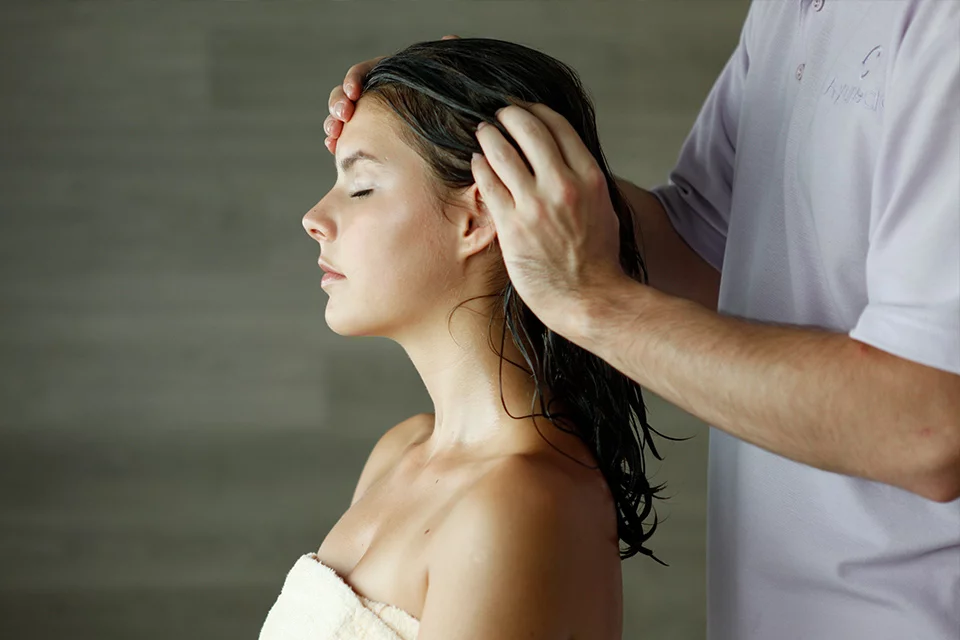
In a Shiro Abhyanga session you sit upright while a therapist pours warm herbal oil on the crown of your head. It is worked into the scalp with fingertips and palms, and the strokes then move down the neck and across the shoulders. Afterwards you leave the oil in for an hour or two if you can, then wash with mild shampoo and lukewarm water.
Shiro Abhyanga is the Ayurvedic head massage with warm oil. In a session you sit upright on a stool or chair while the therapist pours warm herbal oil on the crown of your head. It is worked into the scalp with fingertips and palms, and the strokes then move down the neck and across the shoulders. This article follows one session from booking to the hair wash afterwards.
What is Shiro Abhyanga?
Shiro, also written siro, means head. Abhyanga means oiling with massage. On our treatment list it appears as Siro Abhyanga.
The practice belongs to the daily routine in the classical texts. The Charaka Samhita (Sutrasthana 5) advises keeping the head oiled every day. It links the habit with fewer headaches, less greying and hair fall, and sound sleep. Those are the text's claims, and no trial we know of has checked them.
The Ashtanga Hridaya (Sutrasthana 22) names four ways of putting oil on the head: massage, pouring, a soaked pad on the crown, and oil held inside a cap. It ranks them by strength, and massage is the first and mildest. The text gives head massage for dryness and itching of the scalp.
Before you book: who should wait or check with a doctor?
A head massage is a light therapy, but there are days and conditions it does not suit. Wait, or ask first, in these cases:
- You have a fever, a heavy cold or blocked sinuses on the day.
- You have cuts, sores or an infection on the scalp.
- You have had a recent head or neck injury, or neck surgery. Speak to your doctor first.
- You have just had your hair coloured or chemically processed. Ask your stylist how long to wait.
The classical texts add their own limits. The Sushruta Samhita (Chikitsasthana 24) rules out oil massage in acute fever and in indigestion.
Some headaches belong with a doctor and not with a therapist. The NHS page on tension headaches lists a headache after a head injury, and a sudden, extremely painful headache, as emergencies. It advises seeing a doctor for headaches that come several times a week.
Hair and scalp worries are similar. The NHS page on hair loss says there is usually no need to worry, although now and then a medical condition is behind it. Have a doctor find the cause, it advises, before you pay a commercial hair clinic.
We promise no result for hair or scalp from a head massage. If hair loss is your reason for booking, read our hair loss page first.
What to wear and bring
Wear a top with a loose or low neckline, because the strokes go down the neck and across the shoulders. Bring a scarf, a cap or a hair clip for the trip home.
Decide before you come whether you will wash your hair that day. If you are going back to work, ask for less oil. The therapist will ask about this anyway.
Shiro Abhyanga is a short therapy and is easy to add to another session. Say so when you book if you want the two together.
The session, step by step
Step one: choosing the oil
The therapist asks how much pressure you like and whether you plan to wash your hair that day. Then the oil is warmed until it feels comfortable on the back of the hand.
The base is coconut or sesame oil. It may be a herbal oil made with Bhringraj, Brahmi or Amalaki, such as Neelibhringadi or Brahmi oil. The practitioner chooses by your constitution, which Ayurveda calls prakriti, and by the season. Sushruta gives the same rule: oil is chosen by habit, constitution, place, season and the dosha involved.
Step two: oil on the crown
You sit upright. The therapist pours warm oil on the crown, then parts the hair and spreads oil along each parting. The point is to reach the scalp. Oil that only coats the lengths of the hair has missed it.
Step three: the scalp massage
The therapist makes small circles with the fingertips across the whole scalp, then uses the flat of the palms. Long strokes run from the hairline back to the nape of the neck. Near the roots, the hair is gently lifted and let go.
Tell the therapist if the pressure is too firm or too light.
Step four: temples, ears, neck and shoulders
The thumbs make slow circles at the temples and behind the ears. The hands then move down the back of the neck and squeeze along the tops of the shoulders. The session ends there, with the oil still in your hair.
What should you do afterwards?
Leave the oil in for an hour or two if you can. Then wash it out with a mild shampoo. If you need to wash sooner, that is fine.
Use lukewarm water on the head. The Ashtanga Hridaya (Sutrasthana 2) says warm water suits the body but weakens the hair and the eyes when poured on the head. Our article on Ayurvedic eye care looks at that claim from the side of the eyes.
Cover your head before you walk into strong air conditioning or wind. In Dubai that means the car and the mall, which is what the scarf is for.
How often is a head massage taken?
The tradition is frequent and domestic. Head oiling was done at home, daily or several times a week. In a clinic it is commonly taken weekly or fortnightly.
Between visits you can oil your own scalp. Our guide to Abhyanga at home covers oiling yourself.
Has head massage with oil been tested?
We know of no clinical trial of Shiro Abhyanga itself. A few studies sit close to it, and none is strong.
On hair, a 2016 study of nine healthy men had them use a scalp massage device for four minutes a day over 24 weeks. It reported a rise in mean hair thickness and had no comparison group. No oil was used, and hair loss was not measured.
A 2019 survey asked people with self assessed hair loss about regular scalp massage. About 69 per cent of those who answered reported that their hair loss had steadied or that hair had regrown. Only 340 of the 1,899 people contacted replied, and every result was self reported.
On the oil, a 2022 systematic review covered 22 articles on coconut, castor and argan oil. The evidence it found on hair growth was limited, and coconut oil had some support for brittle hair. Our article on Ayurvedic hair and scalp care goes further into oils.
On headache and tight shoulders, the US National Center for Complementary and Integrative Health sums up massage research. For headache it found only a few studies, with inconsistent results. For neck and shoulder pain it says massage may help, and that the benefit may be short lived.
On stress, a 2011 pilot study gave 20 healthy adults a single one hour Abhyanga oil massage. Their self rated stress and heart rate were lower afterwards. It had no comparison group, and it was not a study of head massage. See also our stress and sleep page.
Shiro Abhyanga, the express massage and Talapothichil compared
Three scalp therapies on our list are easy to confuse.
| Therapy | What goes on the head | What the therapist does | People usually book it when |
|---|---|---|---|
| Siro Abhyanga | Warm herbal oil, poured on the crown. | Massages the whole scalp, then the neck and shoulders. | Scalp, neck and shoulders feel tight after desk work. |
| Head, Neck and Shoulder Massage | Warm oil on the crown. | Massages the scalp, kneads the neck, uses deeper strokes on the shoulders. | They want a short session with little undressing. |
| Talapothichil | A thick, cool paste of ground herbs. | Packs it over the scalp, covers it and lets you rest. | The head feels hot, heavy or overworked, or in summer. |
The Head, Neck and Shoulder Massage starts the same way. It then has separate steps for the neck and the shoulders, with deeper strokes along the shoulder muscle. It may suit you better if your shoulders are what bother you.
Talapothichil is a different kind of therapy. The name is Malayalam: tala means head and pothichil means wrapping. The paste is dried Amalaki, the Indian gooseberry, soaked in buttermilk and ground. It is packed about a finger thick under a banana or lotus leaf, and there is no massage while you rest.
Booking a session at 22 Ayur
Our therapists trained in Kerala, and female therapists are available on request. If you want head massage planned as part of a wider Ayurvedic programme, book an Ayurveda consultation. Consultations in Ayurveda are with Dr Thasni, who is our medical director and a DHA licensed Ayurveda practitioner.
You will find 22 Ayur on Al Mina Road in Jumeirah, near Port Rashid and a short drive from Satwa, Bur Dubai and Al Karama. It is open Tuesday to Friday from 10:00 to 21:30, and Saturday and Sunday from 09:00 to 21:30. On Mondays it is closed. To book, use WhatsApp or phone from our contact page.
Questions people ask
Can I go back to work with oil in my hair?
Yes, with a little planning. Ask the therapist for less oil, and bring a clip, a scarf or a cap. Leaving the oil in for an hour or two is the traditional advice, but you can wash it out whenever suits you.
Will Shiro Abhyanga stop my hair falling?
We do not promise any result for hair or scalp. The classical texts link head oiling with less hair fall, but we know of no trial of Shiro Abhyanga. If your hair loss worries you, see a doctor to find the cause first, as the NHS advises.
How firm is the pressure?
As firm as you ask for. The therapist asks how much pressure you like before starting. The scalp work is done with fingertips and the flat of the palms. Say at any point if you want it lighter or firmer.
Can I have a head massage straight after colouring my hair?
Not straight after. Our treatment notes for Siro Abhyanga say to wait after a hair colour or a chemical service. Your stylist knows the product used, so ask how long to wait and book for after that date.
Can I add Shiro Abhyanga to another therapy?
Yes. It is a short therapy and is easy to add to another session. Tell us when you book by WhatsApp or phone, and say whether you plan to wash your hair that day, because the therapist will ask.
Sources
- Charaka Samhita, Sutrasthana 5 (Matrashiteeya Adhyaya), verses 81 to 92. Charak Samhita Research, Training and Development Centre.
- Ashtanga Hridaya, Sutrasthana 22 (Gandushadi Vidhi), PDF pages 367 to 370. Verse markers 26 to 33 are legible on these pages. Chaukhamba Surbharati Prakashan, Varanasi; PDF hosted by Karnataka Samskrit University.
- Sushruta Samhita, Chikitsasthana 24 (Anagatabadha Pratishedha). Wisdom Library, text of K. K. L. Bhishagratna's English translation.
- Tension headaches. NHS, 2025.
- Hair loss. NHS, 2024.
- Ashtanga Hridaya, Sutrasthana 2 (Dinacharya), PDF pages 66 to 70. Legible. Chaukhamba Surbharati Prakashan, Varanasi; PDF hosted by Karnataka Samskrit University.
- Standardized Scalp Massage Results in Increased Hair Thickness by Inducing Stretching Forces to Dermal Papilla Cells in the Subcutaneous Tissue. Koyama T et al, Eplasty, 2016.
- Self-Assessments of Standardized Scalp Massages for Androgenic Alopecia: Survey Results. English RS and Barazesh JM, Dermatology and Therapy, 2019.
- Coconut, Castor, and Argan Oil for Hair in Skin of Color Patients: A Systematic Review. Phong C et al, Journal of Drugs in Dermatology, 2022.
- Massage Therapy: What You Need To Know. National Center for Complementary and Integrative Health, US National Institutes of Health, 2019.
- Pilot study investigating the effects of Ayurvedic Abhyanga massage on subjective stress experience. Basler AJ, Journal of Alternative and Complementary Medicine, 2011.
“Shiro Abhyanga: Ayurvedic Head Massage, Step by Step” was written by the 22 Ayur clinic team. It was published and last updated . It describes traditional practice and is not medical advice. For advice on your own situation, an Ayurveda consultation at 22 Ayur is with Dr Thasni, the clinic’s medical director, who is licensed by the Dubai Health Authority as an Ayurveda Practitioner. How we review content.
Related care at 22 Ayur
- Siro Abhyanga
Warm herbal oil is poured on the crown and massaged by hand into the scalp, then along the neck and shoulders.
- Head, Neck & Shoulder Massage
A short massage in which warm oil is worked through the scalp, then down the neck and across the shoulders.